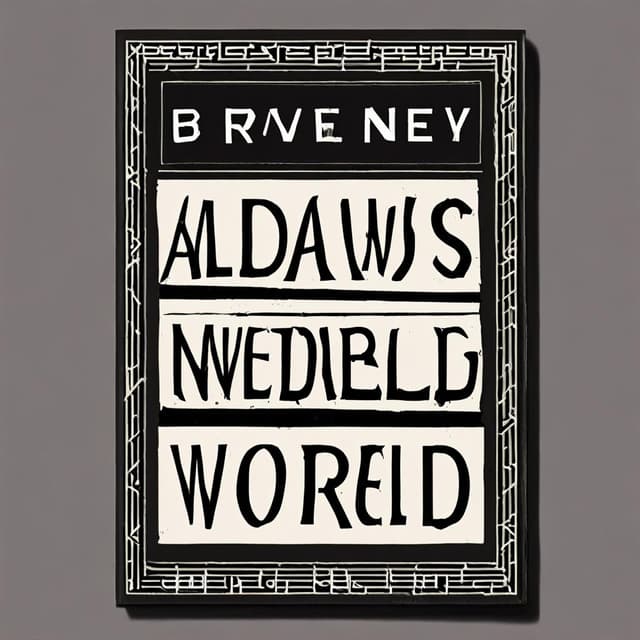
| Plot | Presents a dystopian vision of the future, rather than the utopian society it was intended to depict. The 'World State' uses advanced technologies like genetic engineering, psychological conditioning, and drug treatments to create a rigidly controlled and pacified population. Individual identity, free will, and human relationships are heavily suppressed in the name of social stability and efficiency. |
| Genre | Dystopian fiction • Science fiction |
| Title | Brave New World |
| Author | Aldous Huxley |
| Themes | Totalitarianism • Dehumanization • Social control • Individuality vs. conformity • Technology and its impact on society |
| Setting | Futuristic, totalitarian 'World State' |
| Publication year | 1932 |
In the early 20th century, the British author Aldous Huxley wrote his seminal 1932 novel "Brave New World" as a cautionary tale about the dangers of an over-rationalized, technocratic society. However, in this alternate timeline, the "World State" depicted in Huxley's book represents not an idealized utopia, but rather a disturbing dystopia.
The "World State" in Huxley's novel is a global totalitarian regime that utilizes advanced scientific and technological means to rigidly control its citizens. Through genetic engineering, psychological conditioning, and a drug called "Soma," the government ensures social stability and the suppression of individuality.
Babies are produced in hatcheries and nurseries, then divided into a rigid caste system based on their genetically-engineered abilities and social roles. Citizens are conditioned from birth to accept their predetermined place in society and to find happiness and fulfillment in their assigned tasks and pleasures.
Even basic human relationships are discouraged, as the World State views social bonds and emotional attachments as threats to its order and efficiency. Promiscuity is actively encouraged, while family structures and reproductive autonomy are forbidden. The ultimate goal is a homogenized, passive populace that never questions the status quo.
Far from the "utopia" Huxley may have originally envisioned, this version of the World State is a deeply dystopian society. The elimination of individuality, freedom of choice, and meaningful human connection represents an unnerving totalitarian nightmare. The rationalized, mechanized control of the populace through biotechnology and psychological manipulation is a chilling foreshadowing of the worst excesses of authoritarian regimes.
In this timeline, "Brave New World" does not depict an aspirational future, but rather a cautionary tale about the dehumanizing potential of a society prioritizing efficiency, stability and control over individual liberty and the richness of the human experience. Huxley's vision has become a sobering mirror, reflecting the dangers of unchecked technological advancement and the suppression of our essential humanity.
Even in this alternate reality where "Brave New World" presents a dystopian rather than utopian future, Huxley's novel remains a touchstone of 20th century literature. Its themes of totalitarian control, the dangers of groupthink, and the erosion of individuality continue to resonate across the decades.
As technological advancement and social engineering techniques have become increasingly sophisticated, "Brave New World" has only grown more prescient. Huxley's ability to imaginatively extrapolate the logical conclusions of certain societal and scientific trends has cemented the book's legacy as a work of unsettling foresight.
Ultimately, this version of "Brave New World" stands not as an idealized vision of the future, but as a stark warning. It reflects the very real perils of a world that prioritizes order, efficiency and control over human freedom and dignity. In an era of ever-expanding government and corporate power, Huxley's dystopian masterpiece remains an essential cautionary tale.
